
I have been using the Samsung Galaxy S10e for over a month now, and I think it’s definitely the best flagship handset for the average consumer in 2019. Here’s why. The Samsung Galaxy S10e was released as a direct competition to the iPhone XR, and it does so much better for the same price, that I really have trouble recommending it to anyone other than a die-hard Apple fan, whereas the S10e, I feel like I can recommend it to anyone looking for a flagship, especially because of that price. Now, onto the review.
Display
Tech Specs – 5.8 inch Dynamic AMOLED with 2280×1080 resolution at 438 ppi
– 800 nits of max brightness
– HDR 10+ Certified
Samsung is known for is brilliant high-quality display’s and while using this phone I was still amazed at how vibrant the colours are, and how deep the blacks are. This phone makes me want to watch content on it, and I find myself casting to my TV less and less because the viewing experience is just so good. Everything looks very crisp because of the 438ppi on the smaller 5.8-inch display. The display is brilliant in direct sunlight as it gets very bright, but I didn’t have any trouble using it at night either especially with the new system-wide dark mode on Samsung’s One UI. Personally, I must prefer the hole punch display to all shapes and flavours of ‘the notch’ even the wider hole punch on the S10+ is preferable to the intrusive notch on the iPhone XS or XR or, God forbid, the Pixel 3 XL notch. I love the tall 19:9 display because it allows me to fit so much more on my screen while scrolling through Facebook or watching Netflix than my old iPhone 6.
Performance
Tech Specs – Exynos 9820 Octa-core Processor 2x 2.7 GHz Large Cores, 2x 2.3 GHz Medium Cores and 4x 1.9GHz High-efficiency cores
– 6GB RAM
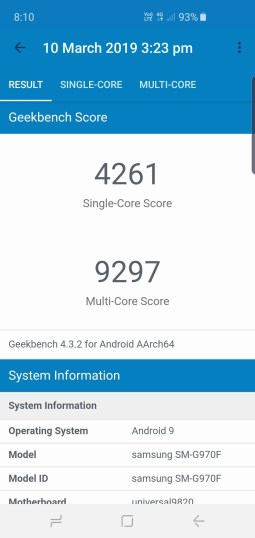
Samsung’s Galaxy series phones have always been fast, with the top of the range processors and lots of RAM, but they have never felt as fast as they do in 2019. One UI is a massive step in the right direction from the dark days of TouchWiz, and I think this phone will be the latest longing that Samsung has made to date. Everything feels super-fast and nippy, and multi-tasking is a breezing with the 6GB of RAM. I can have 8-10 apps open, sometimes even more, and still be able to go back the first opened one without a refresh. The S10e also performs admirably in gaming and doesn’t miss a beat in even the most intensive 3D games on the highest settings, such as PUBG Mobile and Asphalt 9. The Geekbench scores are very impressive, scoring around 4200 for single core, and 9300 for multi-core. Overall, the Galaxy S10e has very impressive performance, more than the average consumer will need in my opinion, but more is better than less in terms of performance.
Camera
Tech Specs – 12MP Wide Angle Rear Camera with Dual Aperture Lens F1.5/2.4
– 16MP Ultra-Wide Angle Rear Camera with F2.2 Aperture
– 10MP Wide-Angle Selfie Camera with F1.9 Aperture
– 4K at 60fps Video Recording with Rear Cameras
– 4K at 30fps Video Recording with Front Camera
– Optical Image Stabilisation
– 960fps Super Slo-Mo
In an age where the gap between DSLRs and Smartphone cameras in closing, Samsung needed to up their game last year to match the likes of Huawei and Apple, and they’ve done it with the S10 series. The S10e has two rear cameras just like the S9+ but this year they have decided on the smaller model, to include two cameras, instead of the three on the larger models. A smart move from Samsung is keeping the more useful of the 3 cameras, the standard and ultrawide lenses. I had lots of fun, especially with the ultrawide, which can take some really interesting images with a whole new perspective on the photo. I no longer find myself having to walk back to get an entire building in the shot or to get both people and what’s behind them in the shot. Both rear cameras produce crisp, true to life images that look great, and not overprocessed, which the Huawei phones often are a subject of. Even in low light, all of the cameras perform great and hold up well after dark. In terms of raw specs, however, the Huawei P30 wins here, and if you’re a photographer looking for a backup, easy to access the camera, this is a better choice for you. The selfie cam produces great pictures as well, and I was especially impressed with the details it retained on my face. 4K video on both the rear and front cameras is a first for smartphones and is a great step in the right direction for smartphone videographers and vloggers alike. The camera app is simple and easy to use, and most of the modes seem necessary, or at least useful, unlike its rival, Huawei. Except for the food mode which produces really weird photos, just use Auto. Please. Scene Optimiser is a welcome inclusion and I almost always have it on, because it works really well. Another really useful feature is flaw detection, which uses AI to see if someone has blinked in your photo or the photo is blurry. Portrait mode, or Live focus, as it’s called on Samsung’s side of the fence works most of the time, but I’ve noticed it’s much better on people than it is on other subjects. Its edge detection is decent, but not great, and it often blurs the top of my head or the edges of my ears. Super slo-mo is a nice inclusion, but it’s very temperamental, and the 720p is really noticeable, so I usually just stick to Slo Motion mode, which records at 1080 at 240fps rather than 720p at 960fps. Overall, all of the cameras are very solid, and hold up better than the XRs lineup, but not the P30s in terms of specs.


Battery Life
Tech Specs – 3100 MAh
I was pleasantly surprised by this phone in terms of battery life, especially given the much smaller battery than the S10e’s larger counterparts. It’s not amazing, but for most people, lasting a day of heavy use is enough, and at that, the S10e performs admirably. The charging speed is also great, but nothing compared to the P30, but when compared to anything from Apple, the S10e smashes it with 15W Fast Charging included out of the box. It takes about 30 minutes to get from 0-50%, but 1 and a half hours from 0-100%. Fast charging is a godsend, and I still can’t grasp the reasoning behind Apple, not including a fast charger in the box of its iPhones. I was also very impressed how the S10e did after a whole day of really heavy use with over 8 hours of screen on time, including over 2 hours of Pokemon Go, which uses almost all of the sensors in the phone simultaneously causing massive battery drain. The phone died on this day at about 5:30 pm which was pretty damn good for a 3100 MAh battery. Wireless charging is also a welcome feature, even though I don’t own a wireless charger, getting that extra bit of juice while in a Starbucks is a great feature. The battery as a whole is nothing to rave about, but it’s good and will defiantly last you a whole day of use.
Features and Software
There is a multitude of useful features on the Galaxy S10e that improve it’s usability and is one of the biggest reasons why you would purchase it over the iPhone XR or Google Pixel 3. It’s not like previous Samsung flagships that were full of useless ‘features’ but things that actually help in your day to day life. Edge panels and lighting is one of the things that every year reviewers seem to miss or brush it off as a niche feature, but I found it really helpful, and it improved my productivity a heap. The fingerprint sensor is common on most smartphones these days, but I still prefer the capacitive sensors to the new in-display tech on the S10 and S10+. One UI is a massive improvement over TouchWiz, and it’s much more useable than any other previous Samsung software. There are still annoying copies of Google’s apps such as Calendar, Internet, Email and a couple of others, but it’s now easier than ever to either uninstall them or hide them. One handed use is so much better in Samsung’s native apps that you will actually use like Messages, Phone, Settings, and the quick settings panel. This is especially useful if you have smaller hands or one of the larger Samsung handsets. They also added a very simple and intuitive gesture navigation system that you can turn on if you want to. They just replaced the standard Android navigation keys with grey bars on the bottom of the screen which you can swipe up on the perform their usual actions. They also added a gesture similar to one seen on Google Pixel phones, where you swipe from the home button to the right to switch to your last used app or scroll along with the multitasking window. Overall Samsung’s software has improved so much, I’m starting to like it more than Stock Android, at least until Android Q is released.
Summary
Overall, I think the Samsung Galaxy S10e is the best phone to buy for people looking for a flagship in 2019, for just $1200AUD you get almost everything from the more expensive S10 and S10+, and considering most people just use their phones for scrolling through Facebook, making a few calls, and taking some pictures of their kids, do you really need a full-blown flagship that’s going to blow your budget?

 Tech Input